ANAESTHESIOLOGY - REGIONAL ANAESTHESIA / SPECIAL ARTICLE
Pericapsular nerve group (PENG) block vs. surgical articular infiltration for direct anterior total hip arthroplasty under general anaesthesia: a randomized pilot trial
1
Department of Anesthesiology, Medipole Villeurbanne Hospital, Villeurbanne, France
2
Department of Anesthesiology & Perioperative Medicine, David Geffen School of Medicine, University of California, Los Angeles, California, USA
3
Department of Anesthesiology & Perioperative Medicine, University of California San Diego, San Diego, California, USA
4
Department of Medicine Statistics Core, David Geffen School of Medicine, University of California Los Angeles, California, USA
Submission date: 2026-01-09
Final revision date: 2026-07-15
Acceptance date: 2026-10-11
Publication date: 2026-10-22
Corresponding author
Alexandre Joosten
Department of Anesthesiology & Perioperative Medicine, David Geffen School of Medicine, University of California, Ronald Reagan UCLA Medical Center, 757 Westwood Plaza, Los Angeles, CA 90095, USA
Department of Anesthesiology & Perioperative Medicine, David Geffen School of Medicine, University of California, Ronald Reagan UCLA Medical Center, 757 Westwood Plaza, Los Angeles, CA 90095, USA
Anaesthesiol Intensive Ther 2026;58(1):212-220
KEYWORDS
hip surgerypain managementpostoperative outcomeslocal anaestheticslidocaineregional anaesthesiaenhanced recovery after surgery
TOPICS
ABSTRACT
Background:
The effectiveness of ultrasound-guided pericapsular nerve group (PENG) blocks for postoperative analgesia following direct anterior total hip arthroplasty under general anaesthesia remains uncertain. We conducted a prospective randomized trial to determine whether a PENG block would reduce postoperative intravenous morphine consumption compared with surgical local anaesthetic infiltration.
Methods:
Consecutive patients were randomized to receive either an ultrasound-guided PENG block after induction of anaesthesia or surgical local anaesthetic infiltration after femoral neck resection. General anaesthesia and perioperative analgesic management were standardized according to institutional practice, and all procedures were performed by a single surgeon. The primary outcome was total intravenous morphine consumption during the post-anaesthesia care unit (PACU) stay. The secondary outcome measure was total oral morphine consumption from PACU discharge to postoperative day 1 (POD#1), expressed in oral morphine equivalents (OME).
Results:
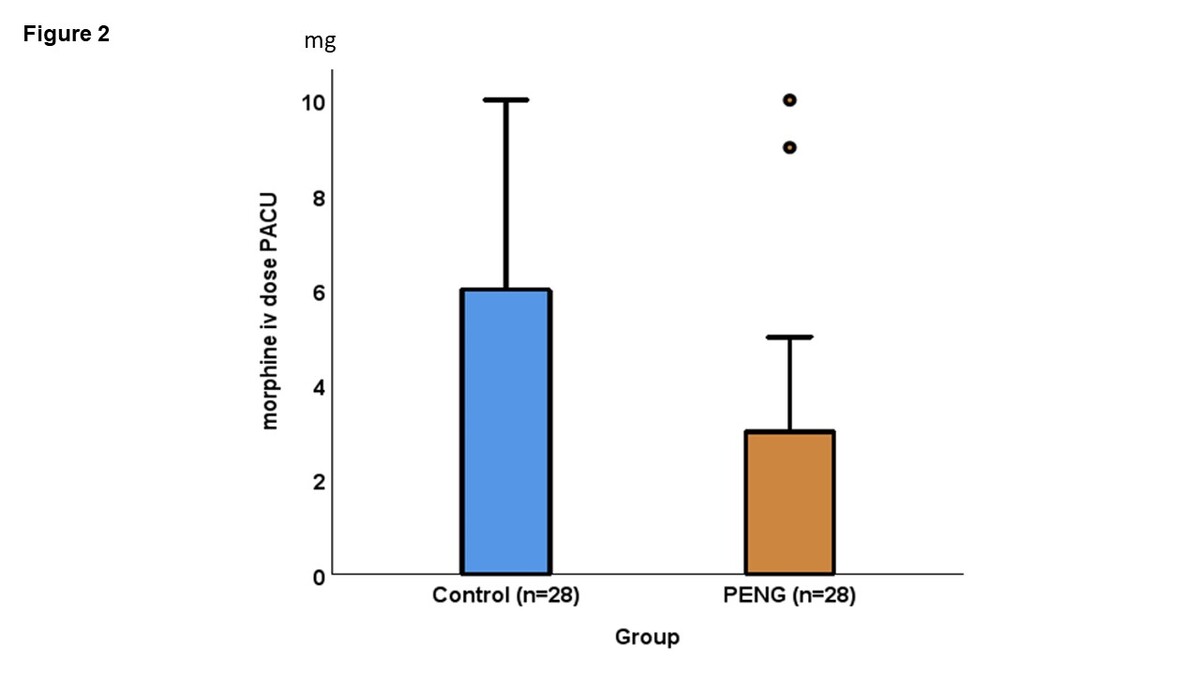
Of the 60 recruited patients, 56 were analysed using a modified intention-to-treat analysis. Median (interquartile range) PACU morphine consumption did not differ significantly between the control and PENG groups (0 [0–6] mg vs. 0 [0–3] mg; median difference 0 mg, 95% confidence interval (CI) −2 to 4.5; P = 0.235). Total OME consumption through POD#1 was lower in the PENG group compared to the control group (0 [0–10] mg vs. 7 [3–20] mg; P = 0.040).
Conclusions:
In patients undergoing direct anterior total hip arthroplasty, PENG block, when implemented as part of a multimodal analgesic pathway, did not reduce PACU intravenous morphine consumption compared with surgical local infiltration.
REFERENCES (20)
1.
Shichman I, Roof M, Askew N, Nherera L, Rozell JC, Seyler TM, Schwarzkopf R. Projections and epidemiology of primary hip and knee arthroplasty in medicare patients to 2040-2060. JBJS Open Access 2023; 8: e22.00112. DOI: 10.2106/JBJS.OA.22.00112.
2.
Patel I, Nham F, Zalikha L, El-Othmani MM. Epidemiology of total hip arthroplasty: demographics, comorbidities and outcomes. Arthroplasty 2023; 5: 2. DOI: 10.1186/s42836-022-00156-1.
3.
Memtsoudis SG, Cozowicz C, Bekeris J, Bekere D, Liu J, Soffin EM, et al. Peripheral nerve block anesthesia/analgesia for patients undergoing primary hip and knee arthroplasty: recommendations from the International Consensus on Anesthesia-Related Outcomes after Surgery (ICAROS) group based on a systematic review and meta-analysis of current literature. Reg Anesth Pain Med 2021; 46: 971-985. DOI: 10.1136/rapm-2021-102750.
4.
Niemeläinen M, Kalliovalkama J, Aho AJ, Moilanen T, Eskelinen A. Single periarticular local infiltration analgesia reduces opiate consumption until 48 hours after total knee arthroplasty. A randomized placebo-controlled trial involving 56 patients. Acta Orthop 2014; 85: 614-619. DOI: 10.3109/17453674.2014.961399.
5.
Girón-Arango L, Peng PWH, Chin KJ, Brull R, Perlas A. Pericapsular nerve group (PENG) block for hip fracture. Reg Anesth Pain Med 2018; 43: 859-863. DOI: 10.1097/AAP.0000000000000847.
6.
Nielsen ND, Greher M, Moriggl B, Hoermann R, Nielsen TD, Børglum J, Bendtsen TF. Spread of injectate around hip articular sensory branches of the femoral nerve in cadavers. Acta Anaesthesiol Scand 2018; 62: 1001-1006. DOI: 10.1111/aas.13122.
7.
Kukreja P, Uppal V, Kofskey AM, Feinstein J, Northern T, Davis C, et al. Quality of recovery after pericapsular nerve group (PENG) block for primary total hip arthroplasty under spinal anaesthesia: a randomised controlled observer-blinded trial. Br J Anaesth 2023; 130: 773-779. DOI: 10.1016/j.bja.2023.02.017.
8.
Lin DY, Brown B, Morrison C, Fraser NS, Chooi CSL, Cehic MG, et al. The pericapsular nerve group (PENG) block combined with local infiltration analgesia (LIA) compared to placebo and LIA in hip arthroplasty surgery: a multi-center double-blinded randomized-controlled trial. BMC Anesthesiol 2022; 22: 252. DOI: 10.1186/s12871-022-01787-2.
9.
She C, Liu H. The efficacy of pericapsular nerve group block for reducing pain and opioid consumption after total hip arthroplasty: a systematic review and meta-analysis. J Orthop Surg Res 2024; 19: 229. DOI: 10.1186/s13018-024-04707-x.
10.
Ferré F, Rey J, Bosch L, Menut R, Ferrier A, Ba C, et al. Pericapsular nerve group (PENG) block combined with local infiltration analgesia is not superior to local infiltration analgesia for the management of postoperative pain after primary elective total hip arthroplasty: A prospective, randomized, controlled, single-blind trial. Heliyon 2024; 10: e33766. DOI: 10.1016/j.heliyon.2024.e33766.
11.
Cho HS, Lee BR, Kwon HM, Park JY, Ham HW, Lee WS, et al. Pericapsular nerve group block with periarticular injection for pain management after total hip arthroplasty: a randomized controlled trial. Yonsei Med J 2025; 66: 233-239. DOI: 10.3349/ymj.2024.0098.
12.
Aubrun F, Monsel S, Langeron O, Coriat P, Riou B. Postoperative titration of intravenous morphine. Eur J Anaesthesiol 2001; 18: 159-165. DOI: 10.1046/j.0265-0215.2000.00796.x.
13.
Laigaard J, Pedersen C, Rønsbo TN, Mathiesen O, Karlsen APH. Minimal clinically important differences in randomised clinical trials on pain management after total hip and knee arthroplasty: a systematic review. Br J Anaesth 2021; 126: 1029-1037. DOI: 10.1016/j.bja.2021.01.021.
14.
Gewandter JS, Dworkin RH, Turk DC, Farrar JT, Fillingim RB, Gilron I, et al. Research design considerations for chronic pain prevention clinical trials: IMMPACT recommendations. Pain Rep 2021; 6: e895. DOI: 10.1097/PR9.0000000000000895.
15.
Karlsen APH, Pedersen C, Laigaard J, Thybo KH, Gasbjerg KS, Geisler A, et al. Minimal important difference in opioid consumption based on adverse event reduction – a study protocol. Acta Anaesthesiol Scand 2023; 67: 248-253. DOI: 10.1111/aas.14175.
16.
Chassery C, Atthar V, Marty P, Vuillaume C, Casalprim J, Basset B, et al. Opioid-free versus opioid-sparing anaesthesia in ambulatory total hip arthroplasty: a randomised controlled trial. Br J Anaesth 2024; 132: 352-358. DOI: 10.1016/j.bja.2023.10.031.
17.
Clanet M, Touihri K, El Haddad C, Goldsztejn N, Himpens J, Fils JF, et al. Effect of opioid-free versus opioid-based strategies during multimodal anaesthesia on postoperative morphine consumption after bariatric surgery: a randomised double-blind clinical trial. BJA Open 2024; 9: 100263. DOI: 10.1016/j.bjao.2024.100263.
18.
Austin PC. Balance diagnostics for comparing the distribution of baseline covariates between treatment groups in propensity-score matched samples. Stat Med 2009; 28: 3083-3107. DOI: 10.1002/sim.3697.
19.
Newcombe RG. Two-sided confidence intervals for the single proportion: comparison of seven methods. Stat Med 1998; 17: 857-872. DOI: 10.1002/sim.3697.
20.
Nagpal AS, Brennick C, Occhialini AP, et al. Innervation of the posterior hip capsule: a cadaveric study. Pain Med 2021; 22: 1072-1079. DOI: 10.1093/pm/pnab057.
Share
RELATED ARTICLE
| eISSN: | 1731-2531 |
| ISSN: | 1642-5758 |

We process personal data collected when visiting the website. The function of obtaining information about users and their behavior is carried out by voluntarily entered information in forms and saving cookies in end devices. Data, including cookies, are used to provide services, improve the user experience and to analyze the traffic in accordance with the Privacy policy. Data are also collected and processed by Google Analytics tool (more).
You can change cookies settings in your browser. Restricted use of cookies in the browser configuration may affect some functionalities of the website.
You can change cookies settings in your browser. Restricted use of cookies in the browser configuration may affect some functionalities of the website.