Caesarean delivery (CD) is one of the most frequently performed surgical procedures worldwide. Adequate postoperative pain management is essential not only for maternal comfort but also for early mobilisation, facilitation of breastfeeding, prevention of chronic postoperative pain, and overall maternal satisfaction. Contemporary perioperative care models, including enhanced recovery after CD protocols, emphasise multimodal and opioid- sparing analgesic strategies [1].
Intrathecal morphine (ITM) administered during spinal anaesthesia provides reliable and prolonged analgesia and is considered the standard of care for elective CD [2, 3]. Nevertheless, its use may be limit ed by contraindications, intolerance, or adverse effects such as pruritus, nausea, vomiting, and, rarely, respiratory depression. Consequently, regional anaes thesia techniques targeting the abdominal wall have been increasingly investigated as alternatives [2, 4]. This narrative review was informed by structured search of PubMed, Scopus, and Cochrane databases, focusing on randomised controlled trials (RCTs), meta-analyses, and society guidelines published between 2010 and 2026, with particular emphasis on studies evaluating post-caesarean anal-gesia.
ANATOMICAL CONSIDERATIONS OF ABDOMINAL WALL BLOCKS
The anterolateral abdominal wall extends from the costal margin and the xiphoid process of the sternum superiorly to the iliac crests and the pubic crest of the pelvis inferiorly, and reaches the posterior axillary line laterally. It consists of four muscles. The rectus abdominis muscle lies on the anterior surface along the midline, extending from the xiphoid process and subcostal margin to the pubic crest. It is covered by the rectus sheath, which is formed by the aponeuroses of three flat muscles that form the lateral abdominal wall: the most superficial external oblique, the internal oblique, and the innermost transversus abdominis muscle. All these muscular structures can be readily visualised with ultrasound imaging [5].
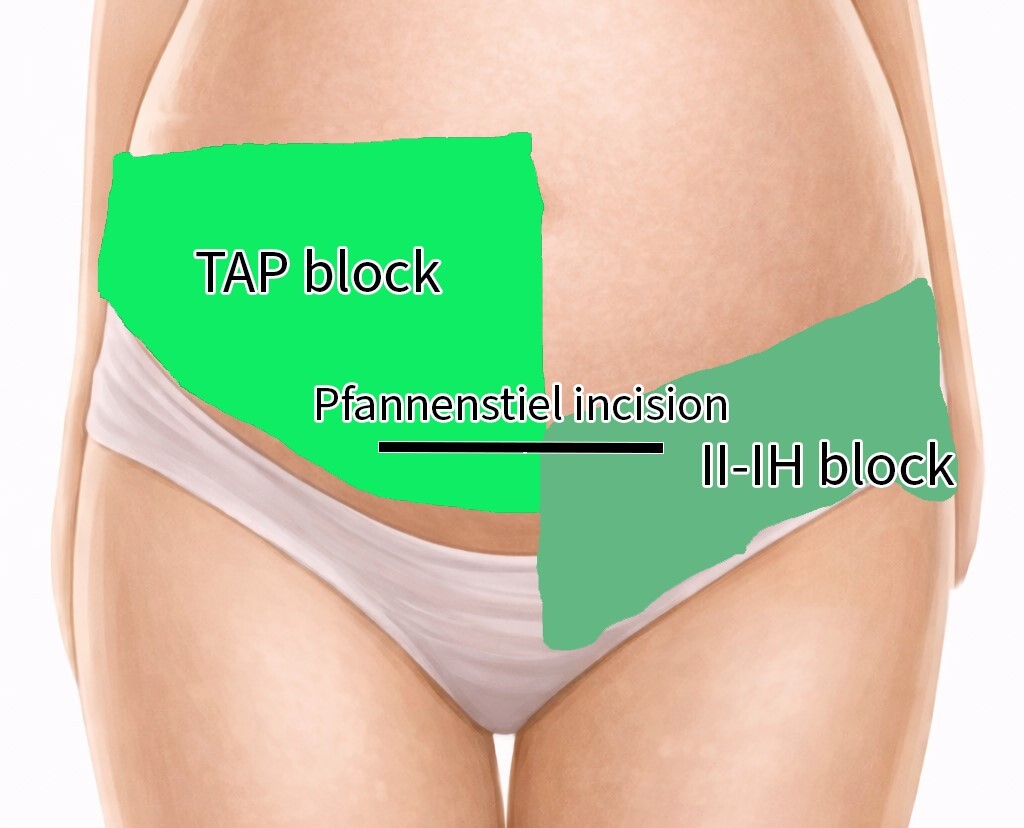
Innervation of the anterolateral abdominal wall is provided by thoracoabdominal nerves formed from the anterior rami of the T6–T12 spinal nerves and by the ilioinguinal and iliohypogastric nerves (II-IH), which are terminal branches of the L1 spinal nerve. Branches of the T6–T12 thoracoabdominal nerves are located in a layer between the internal oblique and transversus abdominis muscles – the transversus abdominis plane (TAP). All branches communicate within the TAP and form the “intercostal plexus”, “TAP plexus”, and “rectus sheath plexus” [5, 6]. As a result of this complex networking, and because T6–T9 nerves tend to enter the TAP more medially, the area of sensory loss when these neural structures are targeted during a TAP block depends substantially on the site of local anaesthetic (LA) injection. The L1 terminal branches run posteriorly beneath the common aponeurosis of the internal oblique and trans-versus abdominis muscles, covered by the transversalis fascia. Further along their course, the II-IH nerves pierce the transversus abdominis muscle and then run through both oblique muscles, innervating the inguinal cutaneous area, the labia majora, and the medial thigh [3]. Targeting both the T6–T12 thoracoabdominal nerves and the II-IH nerves provides a sensory block that may cover the area of the Pfannenstiel incision as well as the Joel-Cohen incision, both used for CD (Figure 1) [5].
FIGURE 1
Approximate area of sensory coverage of lateral and posterior transversus abdominis plane (TAP) block and ilioinguinal and iliohypogastric nerves (II-IH) block in relation to the Pfannenstiel incision (authors’ own work)
The posterior (paraspinal) region of the abdomen consists of the erector spinae muscle group, quadratus lumborum (QL) muscle, psoas major muscle, and the multi-layered thoracolumbar fascia (TLF) [7]. The erector spinae muscles lie posterior to the transverse processes and are enclosed within the posterior layer of the TLF, forming the injection plane for the erector spinae plane block (ESPB). The QL muscle is positioned lateral to the lumbar vertebral bodies and anterior to the erector spinae, separated from the psoas major by the anterior layer of the TLF. The continuity of these fascial layers creates potential pathways for cranio-caudal and medial spread of LA, which may explain the distribution of analgesia observed after QL and ESPBs. In CD, these techniques primarily provide somatic analgesia of the lower thoracic and upper lumbar dermatomes, with possible but inconsistent spread to the paravertebral space that may enhance overall analgesic coverage [7, 8].
ABDOMINAL WALL BLOCKS
Transversus abdominis plane (TAP) block and ilioinguinal-iliohypogastric (II-IH) nerve block
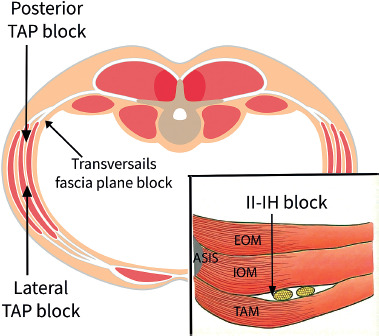
Three main ultrasound-guided TAP block approaches are typically used: subcostal, lateral, and posterior [9]. The subcostal approach is suitable for upper abdominal surgery and does not cover the area of the Pfannenstiel incision. The lateral and posterior approaches are described as deposition of LA between the anterior and mid-axillary lines, and at the most posterior end of the TAP (behind the mid-axillary line), respectively (Figure 2). Both variations are suitable for post-CD analgesia; however, the posterior approach may be associated with LA spread towards the paravertebral space and is therefore considered more effective and preferred over the lateral approach [10, 11]. The L1 terminal branches can be targeted with ultrasound guidance using the classical II-IH block near the anterior superior iliac spine (ASIS), or more proximally by targeting them along their course between the trans-versus abdominis muscle and the transversalis fascia (transversalis fascia plane block – TFPB) (Figure 2) [9].
FIGURE 2
Cross-sectional view of abdominal wall layers showing injection sites for transversus abdominis plane (TAP) block, transversalis fascia plane block (TFPB), and ilioinguinal and iliohypogastric nerves (II-IH) block (authors’ own work)
Although both TAP and II-IH blocks can be performed using landmark techniques, these approaches are considered highly inaccurate, associated with a high failure rate, and are not recommended [12–14]. Both TAP and II-IH blocks are volume- dependent techniques, in which the volume of LA is a key determinant of analgesic efficacy. Various doses and concentrations of long-acting LAs are used in clinical trials, typically 15–20 mL of 0.25% bupivacaine or 0.2–0.375% ropivacaine for TAP block, and 10–15 mL of 0.25–0.5% bupivacaine for II-IH block [15, 16]. Cases of systemic toxicity after TAP block have been reported in parturients, and a study by Griffiths et al. [17] showed that plasma concentrations exceeding the threshold of potential toxicity are possible after high-volume bilateral TAP block [17, 18]. A meta-analysis of RCTs by Ng et al. [19] demonstrated that high- and low-dose TAP blocks (> 50 mg vs. ≤ 50 mg bupivacaine equivalents per side) provide comparable analgesia in terms of total opioid consumption, time to first analgesic request, pain scores, and opioid-related side effects. Regarding ultrasound-guided II-IH block, due to the proximity of the deep circumflex artery and extensive spread of LA within a fascial layer, it may result in higher LA concentrations than the landmark technique [5, 20]. This should be taken into consideration, as post-CD analgesia requires bilateral blocks, and the total dose of LA must not exceed maximum recommended limits.
A key advantage of TAP and II-IH blocks for post-CD analgesia is their relative simplicity, resulting in a short learning curve [21, 22]. Both are considered superficial blocks, making them suitable in patients with bleeding risk or those receiving antithrombotic drugs (e.g. heparin) [23]. As their performance does not rely on targeting individual nerves but rather a fascial plane containing these structures, the risk of neural damage and permanent iatrogenic neurological deficits is low.
TAP block is the most extensively studied abdominal wall block in CD. Randomised trials and meta-analyses consistently demonstrate that TAP block reduces postoperative opioid consumption and improves pain scores when ITM is not administered [2]. Its analgesic effect is primarily somatic, covering the anterior abdominal wall corresponding to lower thoracic dermatomes. However, when ITM is used, the additional benefit of TAP block appears limited. Meta-analyses indicate no clinically meaningful reduction in opioid requirements or pain scores when TAP block is added to neuraxial opioid-based analgesia [2, 4]. This finding is consistent with the mechanism of TAP block, which does not reliably address visceral pain components. Posterior approaches may provide slightly prolonged analgesia compared with lateral techniques, potentially due to spread towards the paravertebral region [10, 11]. Overall, TAP block represents an effective, technically straightforward alternative for postoperative analgesia when neuraxial opioids are contraindicated or omitted.
The II-IH nerve block provides targeted L1 dermatomal coverage and has demonstrated opioid-sparing effects in randomised trials after CD [2, 22]. Meta-analytic data suggest that its analgesic efficacy is comparable to TAP block in patients who do not receive ITM [2, 4, 24, 25]. Because the II-IH block primarily covers the lower abdominal wall and inguinal region, its effect is focused on somatic incisional pain. Its limited dermatomal distribution may be advantageous in selected patients requiring localised analgesia while minimising total LA volume.
Given the partially overlapping, but not identical, dermatomal distribution of thoracoabdominal nerves and L1 branches, combining TAP and II-IH blocks has been proposed to enhance lower abdominal coverage [26]. Clinical studies evaluating combined techniques suggest improved analgesic coverage compared with either technique alone in patients who do not receive ITM, although high-quality comparative data remain limited [26, 27]. The theoretical rationale is that TAP block predominantly covers T10–T12 dermatomes, whereas II-IH block ensures more reliable L1 blockade, which is particularly relevant for the lateral and inferior aspects of the Pfannenstiel incision. Such a combination, the so-called I-TAP block, may be superior to the TAP block alone [27]. From a practical perspective, combining both techniques should be balanced against cumulative LA dose and procedural time. When performed with careful dose calculation, the combined approach may provide broader somatic analgesia in selected patients without neur-axial opioids.
Transversalis fascia plane block (TFPB)
As previously mentioned, L1 terminal branches forming the ilioinguinal and iliohypogastric nerves can also be targeted successfully using the TFPB. A meta-analysis by Dost et al. [28] suggested that this approach effectively reduces opioid consumption and the need for rescue analgesia in parturients. However, further high-quality studies are needed to establish the role of this approach in post-CD analgesia.
Rectus sheath block (RSB)
First described by Schleich [29] in 1899, RSB provides analgesia through blockade of the anterior cutaneous branches of the thoracolumbar nerves [29, 30]. Evidence supporting its use for post-caesarean analgesia is limited. In an RCT comparing RSB with an inactive control in patients receiving spinal anaesthesia with bupivacaine and fentanyl, no significant diffe rences in pain scores or opioid consumption were observed within the first 24 hours; in the same study, TAP block proved superior to both RSB and control [31]. Another RCT evaluating RSB with or without ITM demonstrated that patients who did not receive ITM required more postoperative anal-gesics, and the addition of RSB to ITM did not improve analgesic outcomes compared with placebo RSB [32]. Overall, current evidence does not support the routine use of RSB for postoperative analgesia after CD, particularly when neuraxial opioids are administered.
POSTERIOR-PARASPINAL FASCIAL PLANE BLOCKS Quadratus lumborum block (QLB)
QLB was first described by Rafael Blanco as a posterior variant of the TAP block [33] in 2007. It has since become a commonly used regional anaesthesia technique for pelvic and abdominal surgery. A key anatomical structure implicated in the proposed mechanism of QLB is the TLF; through spread within the TLF, QLB may modulate both somatic and visceral pain pathways [34]. Since the initial description, several variants have been developed based on the injection site of the LA. These include QLB1 (lateral QLB), QLB2 (posterior QLB), QLB3 (anterior or transmuscular QLB), and QLB4 (intramuscular QLB) [35]. The QLB3 (anterior/ transmuscular) approach has been associated with superior postoperative analgesia compared with other QLB types [36, 37]. When comparing QLB with TAP blocks, efficacy appears to depend on the QLB variant: QLB3 may provide more effective analgesia than TAP block, whereas the analgesic effect of QLB2 appears comparable to TAP block [38]. These findings underscore the importance of technique selection in optimising QLB’s analgesic benefits in patients undergoing CD. In light of current evidence, QLB provides better postoperative anal-gesia compared with inactive or no-block controls in patients undergoing CD without ITM, and is associated with reduced opioid consumption and a lower incidence of postoperative nausea and vomiting [39–43]. However, no clear superiority of QLB over ITM has been demonstrated when ITM is used as an adjunct to spinal anaesthesia, and combining QLB with ITM does not appear to improve outcomes beyond ITM alone [39, 40, 42]. Limited data suggest that QLB may offer better analgesia, earlier ambulation, and improved global quality-of-recovery scores compared with intrathecal fentanyl [44]. QLB has been associated with lower 24-hour opioid requirements compared with II-IH nerve block [45]. The addition of dexmedetomidine as an adjuvant to LA in QLB has been shown to prolong time to first rescue analgesia, reduce total rescue analgesic consumption, and improve patient satisfaction without increasing sedation compared with LA alone [46].
Erector spinae plane block (ESPB)
The first application of ESPB for postoperative analgesia after CD was reported by Yamak Altinpulluk et al. [48], in which bilateral blocks at the T9 transverse process level provided dermatomal coverage from T6 to L1. Somatic analgesia from ESPB is generally attributed to spread of LA into the paravertebral space and into the dorsal and ventral rami of the thoracic and lumbar spinal nerves [47, 48], while visceral analgesia may be mediated by an effect on the rami communicantes [49].
Based on current evidence, ESPB may provide effective postoperative analgesia after CD [15, 50]. Several studies have reported no significant differences in postoperative pain control between ESPB and ITM used during spinal anaesthesia [15, 50]. However, ESPB has been associated with an opioid-sparing effect and a longer time to first analgesic request compared with ITM [50]. In contrast, another RCT demonstrated greater opioid reduction with ITM than with ESPB [51]. ESPB has also been shown to reduce opioid requirements within the first 24 hours after CD and, when compared with intrathecal fentanyl, to provide lower VAS pain scores, prolonged time to first analgesic request, reduced need for rescue analgesics, and higher patient satisfaction [52, 53]. In comparison with TAP block, ESPB has been reported to improve pain control, reduce opioid consumption, and increase patient satisfaction [54]. Available studies further indicate that ESPB provides analgesia comparable to QLB, irrespective of the QLB approach, showing similar efficacy to posterior QLB (QLB2) [55] and transmuscular QLB (QLB3) [56, 57], and non-inferiority to QLB3 in one randomised trial [58]. However, conclusions remain limited by methodological heterogeneity and the relatively small size of available trials.
DISCUSSION
Effective postoperative analgesia after CD remains a cornerstone of modern obstetric anaesthesia, particularly within enhanced recovery pathways. Although ITM continues to represent the standard of care due to its reliable and prolonged analgesic effect, its use may be limited by side effects or contraindications [2, 3]. Consequently, increasing attention has been directed towards ultrasound-guided regional anaesthesia techniques as components of multimodal, opioid-sparing strategies. Among abdominal wall blocks, TAP and II-IH nerve blocks are supported by the most consistent clinical evidence. Both techniques effectively reduce post operative opioid consumption and improve pain control when neuraxial opioids are not admini stered [2, 10, 11]. Their superficial location, relatively simple sonoana tomy, and favourable safety profile make them attractive options, particularly in patients with contraindications to neuraxial opioids or in settings where ITM is omitted [24–26]. However, their analgesic effect is predominantly somatic and limit ed to the anterior abdominal wall, which likely explains the lack of clinically meaningful benefit when they are combined with ITM. The combination of TAP and II-IH blocks may theoretically enhance coverage of the Pfannenstiel and Joel-Cohen incisions by ensuring more reliable L1 blockade in addition to lower thoracic dermatomes [26, 27]. Available data suggest potential improvement in analgesic coverage in patients not receiving ITM, although high-quality comparative trials are limited. Importantly, cumulative LA dosing must be carefully considered when combining bilateral fascial plane techniques.
Posterior fascial plane blocks, including QLB and ESPB, have been proposed to provide broader anal-gesic distribution due to possible spread towards the paravertebral space and modulation of both somatic and visceral pathways [34, 48]. Clinical studies demonstrate effective postoperative analgesia and opioid-sparing effects [39–43, 50, 51]. Nevertheless, heterogeneity in block variants, injection sites, outcome measures, and comparator techniques makes definitive conclusions challenging. Current evidence does not demonstrate clear superiority of these techniques over ITM, nor consistent additional bene fit when used in combination with neuraxial opioids [2, 39, 40, 42, 50].
RSB appears to have limited clinical value in this context. Available randomised data do not support its routine use for post-caesarean analgesia, particularly when neuraxial opioids are administered, and it has not demonstrated superiority over TAP block [31, 32].
Overall, selection of a regional anaesthesia technique after CD should be individualised. In patients receiving ITM, the incremental benefit of additional fascial plane blocks appears modest. In contrast, when neuraxial opioids are contraindicated, omitted, or poorly tolerated, ultrasound-guided abdominal wall blocks – particularly TAP, QL and II-IH – represent practical and evidence-based alter natives [1, 2, 4]. Future research should focus on standardised block techniques, clinically meaningful recovery outcomes, and direct head-to-head comparisons within enhanced recovery protocols.
LIMITATIONS OF AVAILABLE EVIDENCE
The current evidence on regional anaesthesia techniques for post-caesarean analgesia is characterised by substantial methodological heterogeneity. Variability in block approaches, LA type and dosage, timing of administration, use of adjuvants, and comparator regimens complicates direct comparison between studies [36, 37, 44, 46]. Additionally, outcome measures differ across trials, with inconsistent reporting of pain scores at rest and during movement, opioid consumption, and recovery parameters. Moreover, many available RCTs are single-centre studies with relatively small sample sizes, potentially limiting external validity and statistical power. Finally, long-term outcomes, including the impact on chronic post-caesarean pain and functional recovery, remain insufficiently investigated.
CONCLUSIONS
Ultrasound-guided regional anaesthesia techniques are important components of multimodal analgesia after CD. TAP and II-IH nerve blocks provide effective somatic analgesia and meaningful opioid-sparing effects, particularly when ITM is not used. QLB may offer broader dermatomal coverage and can serve as a promising alternative to TAP block in selected patients, although definitive superiority has not been established. ESPB demonstrates comparable efficacy, whereas current evidence does not support routine use of RSB for post-caesarean analgesia.