

CRITICAL CARE - ADULTS / ORIGINAL ARTICLE
Persistent inflammation, immunosuppression, and catabolism are associated with impaired lymphocytic mitochondrial metabolism during the early phase of sepsis. A single-center, prospective cohort study
1
Intensive Care Unit, Conceição Hospital Group, Porto Alegre, Brazil
2
Postgraduate Program in Pneumological Sciences, Federal University of Rio Grande do Sul, Porto Alegre, Brazil
3
Laboratory of Neurotrauma and Biomarkers. Department of Biochemistry, Institute of Basic Health Sciences, Federal University of Rio Grande do Sul, Porto Alegre, Brazil
Submission date: 2025-08-06
Final revision date: 2026-05-05
Acceptance date: 2026-06-01
Publication date: 2026-08-03
Anaesthesiol Intensive Ther 2026;58(1):164-171
KEYWORDS
sepsisseptic shockPICSpersistent inflammationimmunosuppressionand catabolism syndromechronic critical illnesslymphopenialymphocytesmitochondrial dysfunctionoxidative phosphorylationcell respirationcatabolism
TOPICS
ABSTRACT
Background:
Lymphopenia and lymphocytic metabolism have been individually associated with poor prognosis in sepsis; however, the relationship between these factors remains poorly understood. We evaluated whether lymphocyte count and lymphocytic mitochondrial metabolism are associated with the development of persistent inflammation, immunosuppression, and catabolic syndrome (PICS).
Methods:
A prospective cohort study was conducted in four clinical-surgical intensive care units (ICUs). We included critically ill patients with sepsis requiring vasopressor support and assessed mitochondrial metabolism in isolated lymphocytes, including Complex I- and II-linked respiration, at sepsis diagnosis (day 1) and on day 3. Absolute lymphocyte counts and derived ratios, e.g., neutrophil-to-lymphocyte ratio (NLR) and platelet-to-lymphocyte ratio (PLR), were evaluated at the same time points. The primary outcome was the association between mitochondrial respiratory function and PICS. Secondary outcomes included associations between lymphocyte counts, derived biomarkers, and mitochondrial respiration.
Results:
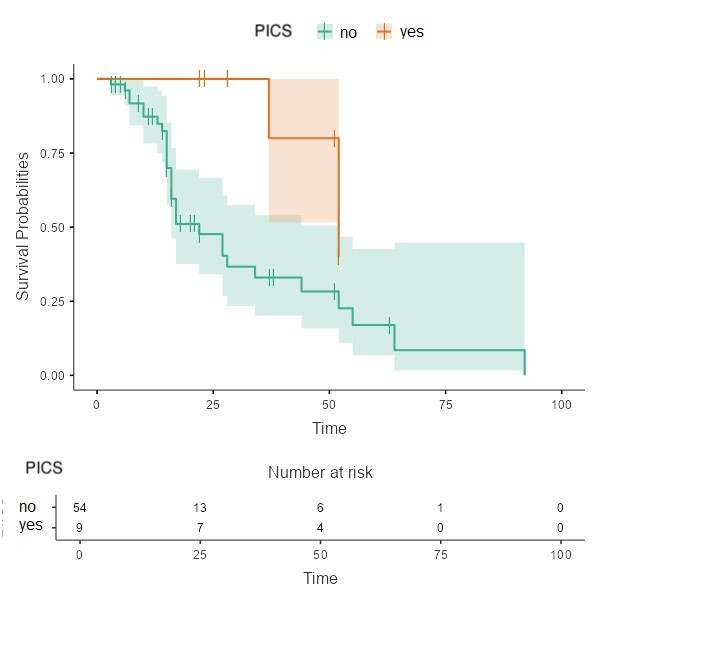
We included 64 patients, 10 of whom developed PICS. At sepsis diagnosis, patients who did not develop PICS exhibited significantly higher Complex I and II-linked respiration compared with those who did (mean difference [MD] for Complex I: 115 pmol O₂ s–1 10–6 cells; 95% CI: 13–291; P = 0.01; MD for Complex II: 171 pmol O₂ s–1 10–6 cells; 95% CI: 31–397; P = 0.01). No significant differences were observed in the delta (day 3 minus day 1) mitochondrial respiration or lymphocyte count between the PICS and non-PICS groups. Additionally, lymphocyte counts and derived ratios showed no significant correlation with Complex I or II respiration, even when stratified by quartiles across time points.
Conclusions:
Our findings suggest that reduced mitochondrial Complex I- and II-linked respiration in lymphocytes at sepsis onset may be associated with the development of PICS. Nevertheless, this association remains exploratory and requires confirmation in larger, adequately powered studies.
Lymphopenia and lymphocytic metabolism have been individually associated with poor prognosis in sepsis; however, the relationship between these factors remains poorly understood. We evaluated whether lymphocyte count and lymphocytic mitochondrial metabolism are associated with the development of persistent inflammation, immunosuppression, and catabolic syndrome (PICS).
Methods:
A prospective cohort study was conducted in four clinical-surgical intensive care units (ICUs). We included critically ill patients with sepsis requiring vasopressor support and assessed mitochondrial metabolism in isolated lymphocytes, including Complex I- and II-linked respiration, at sepsis diagnosis (day 1) and on day 3. Absolute lymphocyte counts and derived ratios, e.g., neutrophil-to-lymphocyte ratio (NLR) and platelet-to-lymphocyte ratio (PLR), were evaluated at the same time points. The primary outcome was the association between mitochondrial respiratory function and PICS. Secondary outcomes included associations between lymphocyte counts, derived biomarkers, and mitochondrial respiration.
Results:
We included 64 patients, 10 of whom developed PICS. At sepsis diagnosis, patients who did not develop PICS exhibited significantly higher Complex I and II-linked respiration compared with those who did (mean difference [MD] for Complex I: 115 pmol O₂ s–1 10–6 cells; 95% CI: 13–291; P = 0.01; MD for Complex II: 171 pmol O₂ s–1 10–6 cells; 95% CI: 31–397; P = 0.01). No significant differences were observed in the delta (day 3 minus day 1) mitochondrial respiration or lymphocyte count between the PICS and non-PICS groups. Additionally, lymphocyte counts and derived ratios showed no significant correlation with Complex I or II respiration, even when stratified by quartiles across time points.
Conclusions:
Our findings suggest that reduced mitochondrial Complex I- and II-linked respiration in lymphocytes at sepsis onset may be associated with the development of PICS. Nevertheless, this association remains exploratory and requires confirmation in larger, adequately powered studies.
REFERENCES (21)
1.
Singer M, Deutschman CS, Seymour CW, Shankar-Hari M, Annane D, Bauer M, et al. The third international consensus definitions for sepsis and septic shock (Sepsis-3). JAMA 2016; 315: 801-810. DOI: 10.1001/jama.2016.0287.
2.
Cheng SC, Scicluna BP, Arts RJW, Gresnigt MS, Lachmandas E, Giamarellos-Bourboulis EJ, et al. Broad defects in the energy metabolism of leukocytes underlie immunoparalysis in sepsis. Nat Immunol 2016; 17: 406-413. DOI: 10.1038/ni.3398.
3.
Martín-Vicente P, López-Martínez C, Lopez-Alonso I, López-Aguilar J, Albaiceta GM, Amado-Rodríguez L. Molecular mechanisms of postintensive care syndrome. Intensive Care Med Exp 2021; 9: 58. DOI: 10.1186/s40635-021-00423-6.
4.
Gentile LF, Cuenca AG, Efron PA, Ang D, Bihorac A, McKinley BA, et al. Persistent inflammation and immunosuppression: a common syndrome and new horizon for surgical intensive care. J Trauma Acute Care Surg 2012; 72: 1491-1501. DOI: 10.1097/TA.0b013e318256e000.
5.
Voiriot G, Oualha M, Pierre A, Salmon-Gandonnière C, Gaudet A, Jouan Y, Kallel H, et al.; la CRT de la SRLF. Chronic critical illness and post-intensive care syndrome: from pathophysiology to clinical challenges. Ann Intensive Care 2022; 12: 58. DOI: 10.1186/s13613-022-01038-0.
6.
Bergmann CB, Beckmann N, Salyer CE, Crisologo PA, Nomellini V, Caldwell CC. Lymphocyte immunosuppression and dysfunction contributing to persistent inflammation, immunosuppression, and catabolism syndrome (PICS). Shock 2021; 55: 723. DOI: 10.1097/SHK.0000000000001675.
7.
Jing J, Wei Y, Dong X, Li D, Zhang C, Fang Z, et al. Characteristics and clinical prognosis of septic patients with persistent lymphopenia. J Intensive Care Med 2024; 39: 733-741. DOI: 10.1177/ 08850666241226877.
8.
Urbanowicz T, Olasińska-Wiśniewska A, Michalak M, Perek B, Al-Imam A, Rodzki M, et al. Pre-operative systemic inflammatory response index influences long-term survival rate in off-pump surgical revascularization. PLoS One 2022; 17: e0276138. DOI: 10.1371/journal.pone.0276138.
9.
Mangoni AA, Zinellu A. Systemic inflammation index, disease severity, and mortality in patients with COVID-19: a systematic review and meta-analysis. Front Immunol 2023; 14: 1212998. DOI: 10.3389/fimmu.2023.1212998.
10.
Zhang Y, Peng W, Zheng X. The prognostic value of the combined neutrophil-to-lymphocyte ratio (NLR) and neutrophil-to-platelet ratio (NPR) in sepsis. Sci Rep 2024; 14: 15075. DOI: 10.1038/s41598-024-64469-8.
11.
Drewry AM, Samra N, Skrupky LP, Fuller BM, Compton SM, Hotchkiss RS. Persistent lymphopenia after diagnosis of sepsis predicts mortality. Shock 2014; 42: 383-391. DOI: 10.1097/SHK.0000000000000234.
12.
Preau S, Vodovar D, Jung B, Lancel S, Zafrani L, Flatres A, et al. Energetic dysfunction in sepsis: a narrative review. Ann Intensive Care 2021; 11: 104. DOI: 10.1186/s13613-021-00893-7.
13.
Nedel WL, Kopczynski A, Rodolphi MS, Strogulski NR, De Bastiani M, Montes THM, et al. Mortality of septic shock patients is associated with impaired mitochondrial oxidative coupling efficiency in lymphocytes: a prospective cohort study. Intensive Care Med Exp 2021; 9: 39. DOI: 10.1186/s40635-021-00404-9.
14.
Nedel W, Strogulski NR, Kopczynski A, Portela LV. Assessment of mitochondrial function and its prognostic role in sepsis: a literature review. Intensive Care Med Exp 2024; 12: 107. DOI: 10.1186/s40635-024-00694-9.
15.
Evans L, Rhodes A, Alhazzani W, Antonelli M, Coopersmith CM, French C, et al. Surviving sepsis campaign: international guidelines for management of sepsis and septic shock 2021. Crit Care Med 2021; 49: e1063-e1143. DOI: 10.1097/CCM.0000000000005337.
16.
Mira JC, Brakenridge SC, Moldawer LL, Moore FA. Persistent inflammation, immunosuppression and catabolism syndrome. Crit Care Clin 2017; 33: 245-258. DOI: 10.1016/j.ccc.2016.12.001.
17.
Wang Z, Zhang W, Chen L, Lu X, Tu Y. Lymphopenia in sepsis: a narrative review. Crit Care 2024; 28: 315. DOI: 10.1186/s13054-024-05099-4.
18.
Dinarello CA. Overview of the IL-1 family in innate inflammation and acquired immunity. Immunol Rev 2018; 281: 8-27. DOI: 10.1111/imr.12621.
19.
Tanaka T, Narazaki M, Kishimoto T. IL-6 in inflammation, immunity, and disease. Cold Spring Harb Perspect Biol 2014; 6: a016295. DOI: 10.1101/cshperspect.a016295.
20.
O’Neill LAJ, Kishton RJ, Rathmell J. A guide to immunometabolism for immunologists. Nat Rev Immunol 2016; 16: 553-565. DOI: 10.1038/nri.2016.70.
21.
Weinberg SE, Sena LA, Chandel NS. Mitochondria in the regulation of innate and adaptive immunity. Immunity 2015; 42: 406-417. DOI: 10.1016/j.immuni.2015.02.002.
| eISSN: | 1731-2531 |
| ISSN: | 1642-5758 |

We process personal data collected when visiting the website. The function of obtaining information about users and their behavior is carried out by voluntarily entered information in forms and saving cookies in end devices. Data, including cookies, are used to provide services, improve the user experience and to analyze the traffic in accordance with the Privacy policy. Data are also collected and processed by Google Analytics tool (more).
You can change cookies settings in your browser. Restricted use of cookies in the browser configuration may affect some functionalities of the website.
You can change cookies settings in your browser. Restricted use of cookies in the browser configuration may affect some functionalities of the website.
